
Security Architecture
A comprehensive technical exposition of SparkVault's enterprise security posture, serverless infrastructure hardening, and multi-layered cryptographic architecture designed to protect your most sensitive data.
Version 2.2 | December 2025
Abstract
This document presents a rigorous technical analysis of SparkVault's cryptographic security architecture, which implements a novel Triple Zero-Trust paradigm requiring cryptographic contributions from three mathematically independent key hierarchies. We detail our implementation of NIST-standardized post-quantum lattice-based key encapsulation (ML-KEM-1024), authenticated encryption with associated data (AES-256-GCM, ChaCha20-Poly1305), HMAC-SHA512 for deterministic salt generation, HKDF-SHA512 for key derivation, and hardware-bound cryptographic operations within FIPS 140-2 Level 3 validated Hardware Security Modules. Our architecture ensures that decryption is computationally infeasible without simultaneous possession of all three root keys, a property that holds even against adversaries with full infrastructure access, legal compulsion authority, or access to cryptographically-relevant quantum computers.
Table of Contents
SparkVault implements a cryptographic architecture wherein data confidentiality is guaranteed by the mathematical impossibility of decryption without simultaneous access to three independent master keys, each held by separate trust domains with orthogonal security boundaries. This represents a fundamental departure from traditional encryption models where a single key holder possesses complete decryption authority.
Our implementation combines ML-KEM-1024 (CRYSTALS-Kyber) lattice-based post-quantum key encapsulation, HMAC-SHA512 via hardware security modules for deterministic salt generation, HKDF-SHA512 for cryptographic key derivation, and dual authenticated encryption modes (AES-256-GCM and ChaCha20-Poly1305) to achieve defense-in-depth across all cryptographic operations.
I. Executive Summary
II. Platform & Infrastructure Security
Cryptographic excellence means nothing if the underlying infrastructure is vulnerable. SparkVault implements defense-in-depth across every layer of our platform, built on enterprise-grade hyperscale cloud infrastructure with security controls that exceed even the most stringent regulatory requirements.
Our infrastructure operates within SOC 1/2/3, ISO 27001, PCI DSS Level 1, and FedRAMP High certified data centers, then adds multiple layers of our own cryptographic hardening on top. The result is an infrastructure security posture that rivals or exceeds most Fortune 500 financial institutions.
Enterprise Security Stack
Multi-layered cloud-native protection with defense-in-depth architecture
We deploy a comprehensive security stack to create an impenetrable perimeter around your data. Every component is configured according to CIS Benchmarks, NIST 800-53 controls, and industry-recognized security frameworks with continuous compliance validation.
Enterprise-grade volumetric attack neutralization with terabit-scale scrubbing capacity, BGP Flowspec integration, and 24/7 Security Operations Center response team.
Layer 7 inspection with ML-based threat classification, custom rule engines blocking SQL injection, XSS, and OWASP Top 10 attack vectors at the network edge.
Deep learning-powered behavioral analysis engine continuously monitoring for anomalous activity patterns, lateral movement, and indicators of compromise across all workloads.
Immutable, hash-chained audit trail with SHA-256 integrity validation. Write-once storage in cryptographically isolated account with tamper-evident logging.
Continuous configuration compliance monitoring with declarative policy enforcement, automatic drift remediation, and real-time security baseline validation.
HSM-protected secrets management with automatic credential rotation, envelope encryption using AES-256-GCM, and zero hardcoded credentials across the entire codebase.
100% Serverless Architecture
Ephemeral compute with zero persistent attack surface
SparkVault runs entirely on serverless infrastructure. There are no traditional servers, no VMs to patch, and no persistent compute instances that could be compromised over time. Each request spawns an ephemeral execution environment that exists only for the duration of that request, then vanishes completely.
All computation occurs in RAM-only environments. No data ever touches persistent disk storage during processing.
Execution environments are destroyed after each request. No state persists between invocations.
There are no servers to SSH into. No backdoors, no remote access vectors, no persistent shells.
Infrastructure scales automatically. No manual provisioning that could introduce configuration drift.
Why This Matters for Security
Traditional servers can be infected with persistent malware, rootkits, or backdoors that survive reboots. With serverless, there's nothing to infect. Every execution environment is freshly created from immutable, cryptographically verified container images. An attacker would need to compromise our deployment pipeline (protected by multiple approval gates) to inject malicious code, and even then it would only affect new deployments, not running systems.
Network Security & Isolation
Defense in depth with zero public exposure
Network Architecture
- Private subnets only: All compute resources run in private subnets with no direct internet access
- No public IP addresses: Internal services are only accessible via VPC endpoints and private links
- Private endpoints: All internal service traffic traverses dedicated private links, never the public internet
- NAT Gateways: Outbound traffic routed through managed NAT with logging
Perimeter Defense
- Global edge network: 400+ points of presence with TLS 1.3 termination and geographic access controls
- Request ingress controller: Adaptive rate limiting, cryptographic API key validation, and per-client usage enforcement
- Security Groups: Stateful firewalls with deny-by-default policies
- Network ACLs: Subnet-level stateless filtering as secondary defense
TLS Configuration
Infrastructure as Code & Immutable Deployments
GitOps-driven infrastructure with cryptographic verification
100% Infrastructure as Code
- Every resource in Git: All infrastructure defined in version-controlled Terraform/CDK
- No manual changes: Console access is read-only; all changes require code review
- Drift detection: Automatic alerts if infrastructure deviates from code
- Policy as Code: Security policies enforced via OPA/Sentinel before deployment
Immutable Deployment Pipeline
- Signed container images: All images cryptographically signed and verified at deploy
- Blue/green deployments: Zero-downtime releases with instant rollback capability
- Multiple approval gates: Automated tests + security scan + manual approval required
- SBOM generation: Software Bill of Materials for every release
Supply Chain Security
End-to-end verification from source to production
Supply chain attacks (like SolarWinds) represent one of the most sophisticated threats facing modern software. We implement comprehensive controls to ensure that only verified, trusted code reaches production.
- • Lockfile integrity validation
- • Checksum verification for all packages
- • Automatic CVE scanning on every build
- • No new dependencies without security review
- • Reproducible builds from source
- • Isolated build environments
- • Signed build artifacts
- • Build provenance attestation (SLSA Level 3)
- • Vendor security assessments
- • Minimal dependency footprint
- • No runtime dependencies on third-party services
- • Regular dependency audits
Passwordless & Zero Standing Access
Mandatory MFA with just-in-time privilege escalation
100% Passwordless Authentication
- No passwords exist in our infrastructure (employee or system)
- Hardware security keys (FIDO2/WebAuthn) required for all access
- Phishing-resistant authentication eliminates credential theft
- Mandatory multi-factor for every authentication event
Least Privilege Access Model
- Zero standing privileges. All access is just-in-time
- Time-boxed access windows with automatic revocation
- Peer approval required for sensitive operations
- Every access request logged and auditable
Continuous Automated Security
Real-time vulnerability detection and prevention
Code Vulnerability Scanning
Every code change is automatically scanned for security vulnerabilities before merge.
- • Static Application Security Testing (SAST)
- • Dependency vulnerability analysis
- • OWASP Top 10 detection
- • Automated blocking of vulnerable merges
Secrets Detection
Automatic scanning prevents accidental exposure of credentials and API keys.
- • Pre-commit secret scanning hooks
- • Historical repository scanning
- • Real-time alerts on detection
- • Automatic PR blocking on secrets
Infrastructure Scanning
Continuous monitoring of cloud configuration for security misconfigurations.
- • Cloud Security Posture Management
- • Infrastructure-as-Code scanning
- • Compliance drift detection
- • Auto-remediation of findings
Independent Security Validation
Third-party penetration testing and security audits
Penetration Testing
Independent security firms conduct monthly penetration tests against our production infrastructure, APIs, and web applications.
- • External network penetration testing
- • API security assessment
- • Web application testing (OWASP methodology)
- • Social engineering assessment
- • Findings remediated within 72 hours (critical) / 30 days (others)
Security Audits & Compliance
Comprehensive annual security audits validate our controls against industry standards and regulatory requirements.
- • SOC 2 Type II audit (Trust Services Criteria)
- • Security framework alignment assessment
- • Cryptographic implementation review
- • Source code security audit
- • Third-party vendor security assessment
Data Isolation & Segregation
Multi-tenant architecture with cryptographic isolation
Tenant Isolation
- Cryptographic isolation: Each account has unique encryption keys, so data is unreadable even with database access
- Network isolation: VPC segmentation prevents cross-tenant network access
- Logical isolation: Row-level security enforced at database layer
Data Residency
- US East deployment: All data stored in US East data centers with multi-AZ redundancy
- Backup isolation: Encrypted backups stored in separate availability zones
- Single-region storage: Data remains within our US East infrastructure
Real-Time Monitoring & Threat Detection
24/7 automated security monitoring with ML-powered anomaly detection
Continuous Monitoring
- Real-time telemetry: Sub-second metrics aggregation across all services with automated anomaly-based alarming
- Centralized logging: All logs aggregated and analyzed in real-time
- Anomaly detection: ML-powered identification of unusual patterns
- Distributed tracing: End-to-end request correlation with cryptographic span identifiers and microsecond-precision latency analysis
Alerting & Response
- Instant alerts: PagerDuty integration for immediate notification
- Automated response: Lambda-driven auto-remediation for common issues
- Runbook automation: Documented procedures for all alert types
- SIEM integration: Security events correlated across all sources
Disaster Recovery & Business Continuity
Multi-AZ architecture with automated failover and rapid recovery
High Availability
- • Multi-AZ deployment across 3+ availability zones
- • Automatic failover with health checks
- • Load balancing with intelligent routing
- • No single points of failure in architecture
- • Database with synchronous replication
Backup & Recovery
- • Continuous encrypted backups
- • Point-in-time recovery (35-day retention)
- • Multi-AZ backup replication
- • Regular disaster recovery drills
- • Documented recovery procedures
Employee & Operational Security
Security-first culture with rigorous controls
- • Background checks on all employees
- • Security training during onboarding
- • Annual security awareness training
- • Regular phishing simulations
- • NDA and confidentiality agreements
- • Managed devices with MDM
- • Full disk encryption required
- • Automatic security updates
- • Endpoint detection & response (EDR)
- • Remote wipe capability
- • Principle of least privilege
- • Separation of duties
- • Change management process
- • Incident response procedures
- • Regular access reviews
Why Enterprise CTOs Trust SparkVault
Our infrastructure security exceeds what most Fortune 500 companies implement internally.
Bottom line: Your data is protected by enterprise-grade hyperscale cloud infrastructure certified for the world's largest banks, healthcare providers, and government agencies, with additional layers of cryptographic protection that make it mathematically impossible for anyone (including SparkVault) to access your data without your authorization.
III. Threat Model & Security Objectives
Adversarial Capabilities Considered
SparkVault's cryptographic architecture is designed to maintain semantic security (IND-CCA2) and ciphertext indistinguishability against polynomial-time adversaries possessing any combination of the following capabilities, a threat model exceeding that of virtually any comparable secrets management platform:
Complete Infrastructure Compromise (Adaptive CCA)
Full read/write access to all SparkVault servers, databases, HSM clusters, and network infrastructure with root-level privileges. Adversary may observe all RAM contents, intercept all I/O operations, and execute arbitrary code, yet cryptographic guarantees remain intact.
Legal Compulsion & Coercion Resistance
Lawful requests requiring SparkVault to produce decrypted data, including FISA orders, national security letters, and extraterritorial legal demands. Our architecture provides cryptographic deniability: we literally cannot comply even under duress.
Malicious Insider (Collusion-Resistant)
Malicious employees with administrative access including DBAs, SREs, and security personnel. Even collusion between multiple SparkVault employees cannot compromise vault contents due to key isolation across independent trust domains.
Cryptographically-Relevant Quantum Computers (CRQC)
Adversaries with fault-tolerant quantum computers capable of running Shor's algorithm against RSA-4096, ECDSA P-384, and classical Diffie-Hellman. Our ML-KEM-1024 lattice-based KEM provides NIST Level 5 post-quantum security (equivalent to AES-256).
Side-Channel Exploitation (DPA/SPA/EMA)
Differential Power Analysis (DPA), Simple Power Analysis (SPA), electromagnetic emanation analysis (EMA), cache-timing attacks (Flush+Reload, Prime+Probe), and speculative execution vulnerabilities (Spectre/Meltdown variants). Constant-time implementations with hardware isolation.
Advanced Persistent Network Adversary
Complete visibility into all network traffic with BGP hijacking capability, valid CA certificates, and ability to perform active MITM attacks. Ephemeral key exchange with cryptographic binding defeats session hijacking.
Obsessively Paranoid Security Guarantee
Under our threat model, an adversary with any two of the three root keys cannot decrypt protected data, not even with unlimited computational resources. The data encryption key (DEK) is derived via HKDF-SHA512 from the concatenation of three cryptographically independent shared secrets: ss₁ || ss₂ || ss₃. Without all three inputs, the resulting DEK has 256-bit entropy indistinguishable from random noise.
This is not a policy decision or access control. It is a mathematical impossibility. SparkVault cannot decrypt your data. Our cloud provider cannot decrypt your data. A nation-state adversary with complete infrastructure access cannot decrypt your data. This level of cryptographic paranoia is virtually unmatched in the secrets management industry.
IV. Triple Zero-Trust Architecture
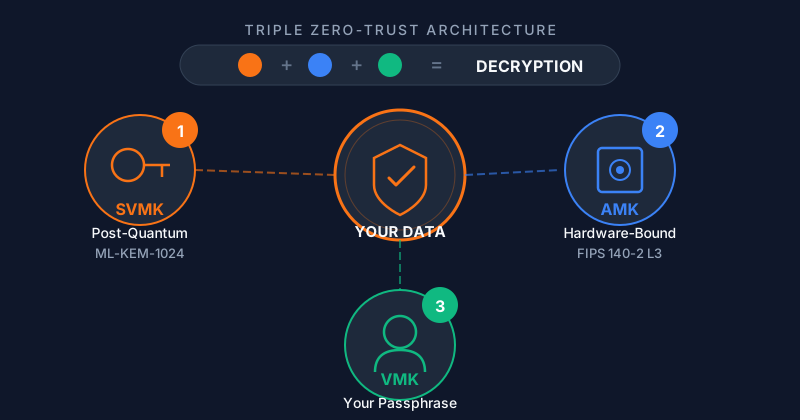
SparkVault's Triple Zero-Trust model implements a novel threshold-free multi-party key agreement protocol distributing cryptographic authority across three mathematically independent trust domains with zero shared entropy. Unlike traditional 2-of-3 threshold schemes (Shamir's Secret Sharing), our architecture requires all three independent Master Keys for any decryption operation, providing strictly stronger security guarantees.
Each key resides in a physically and logically isolated security boundary: (1) post-quantum KEM ciphertext encapsulated under NIST FIPS 203 ML-KEM-1024, (2) hardware-bound HMAC-SHA512 keys non-extractable from FIPS 140-2 Level 3 HSMs, and (3) user-derived passphrase key material combined via HKDF-SHA512. The combination of any two keys without the third produces cryptographically random output with no correlation to the plaintext. This is obsessively paranoid by design: we trust no single party, including ourselves.
ML-KEM-1024 Post-Quantum KEM
CRYSTALS-Kyber lattice-based encapsulation
Module Learning With Errors (M-LWE) based key encapsulation providing IND-CCA2 security against both classical and quantum adversaries. 256-bit shared secret derived from 3168-byte ciphertext with computational security equivalent to AES-256.
NIST FIPS 203 | M-LWE (k=4, η₁=2, η₂=2) | 256-bit classical / 256-bit quantum security
HSM-Bound HMAC-SHA512
Hardware-protected MAC key
Per-account HMAC-SHA512 key that never leaves the FIPS 140-2 Level 3 Hardware Security Module. Generates deterministic 64-byte salts for HKDF key derivation. Non-extractable design means even SparkVault engineers cannot access the raw key material.
HMAC-SHA512 | FIPS 140-2 Level 3 | 512-bit security | Non-extractable
HKDF-SHA512 Hardware-Bound Key
User-derived key with HSM attestation
HMAC-based Key Derivation Function per RFC 5869 with 512-bit extract and expand phases. Key material derived from user passphrase + vault ID + hardware attestation, then cryptographically bound to FIPS 140-2 Level 3 HSM. Private key operations never leave the tamper-resistant boundary.
RFC 5869 | SHA-512 | FIPS 140-2 Level 3 | Hardware attestation chain
Key Combination Protocol
The three root keys are combined via a cryptographically secure key agreement protocol:
// Key 1: Post-quantum KEM decapsulation (SVMK)
svmk_shared_secret = ML-KEM-1024.Decaps(ciphertext, svmk_private_key)
// Key 2: Hardware HMAC for deterministic salt (AMK)
salt = KMS.GenerateMac(HMAC_SHA512, amk_key_id, account_id || vault_id)
// Key 3: User passphrase (VMK)
vmk = user_passphrase // 12-24 character Base62 string
// Final data encryption key via HKDF
DEK = HKDF-SHA512(ikm=svmk_shared_secret || vmk, salt=salt, info="VAK")
V. Cryptographic Key Hierarchy
SparkVault Master Key (SVMK)
Post-Quantum Key Encapsulation Mechanism
Cryptographic Parameters
| Algorithm | ML-KEM-1024 (CRYSTALS-Kyber) |
| Standard | NIST FIPS 203 |
| Public Key Size | 1,568 bytes |
| Ciphertext Size | 1,568 bytes |
| Shared Secret | 32 bytes (256 bits) |
Security Properties
- IND-CCA2 Security: Indistinguishability under adaptive chosen-ciphertext attack
- Quantum Resistance: Security based on Module-LWE hardness assumption
- Classical Security: ≥192-bit equivalent security level
- Quantum Security: ≥128-bit post-quantum security level
Account Master Key (AMK)
Hardware-Bound Symmetric Key
Cryptographic Parameters
| Algorithm | HMAC-SHA512 |
| Standard | FIPS 198-1, RFC 2104 |
| Key Size | 512 bits |
| Output Size | 512 bits |
| Storage | Hardware Security Module |
Security Properties
- Hardware Isolation: Key material never leaves HSM boundary
- Tamper Resistance: FIPS 140-2 Level 3 physical security
- Non-Extractable: Cryptographic operations only, no key export
- Per-Account Isolation: Unique key material per customer account
Vault Master Key (VMK)
Client-Derived Zero-Knowledge Key
Cryptographic Parameters
| Input | 12-24 character passphrase |
| KDF Algorithm | Argon2id (RFC 9106) |
| Memory Cost | 64 MiB |
| Time Cost | 3 iterations |
| Output Size | 256 bits |
Security Properties
- Zero-Knowledge: SparkVault never receives or stores the passphrase
- Memory-Hard: ASIC/GPU-resistant key derivation
- Side-Channel Resistant: Data-independent memory access patterns
- Unrecoverable: Lost passphrase = permanently inaccessible data
Critical Security Note: The VMK is derived entirely client-side and is never transmitted to SparkVault servers. This provides cryptographic proof that SparkVault cannot decrypt vault contents, even under legal compulsion or infrastructure compromise. Loss of the passphrase results in permanent, irrecoverable data loss. This is the mathematical guarantee of your privacy.
VI. Post-Quantum Cryptography
Quantum Threat Analysis
Shor's algorithm, when executed on a cryptographically-relevant quantum computer (CRQC), can efficiently factor large integers and compute discrete logarithms, breaking RSA, DSA, and elliptic-curve cryptography. SparkVault proactively deploys NIST-standardized post-quantum algorithms to ensure long-term data confidentiality against "harvest now, decrypt later" attacks.
Vulnerable Primitives (Not Used)
- RSA (Integer Factorization)
- ECDSA/ECDH (Discrete Log)
- DSA (Discrete Log)
- Classic Diffie-Hellman
Quantum-Resistant Primitives (In Use)
- ML-KEM-1024 (Lattice-based KEM)
- AES-256 (Grover's: 128-bit effective)
- SHA-512 (Grover's: 256-bit effective)
- ChaCha20-Poly1305 (256-bit key)
ML-KEM-1024 Implementation Details
ML-KEM (Module-Lattice Key Encapsulation Mechanism), standardized as NIST FIPS 203, provides IND-CCA2 security based on the computational hardness of the Module Learning With Errors (M-LWE) problem over polynomial rings. Our implementation uses the highest security level (ML-KEM-1024) with parameters (k=4, η₁=2, η₂=2, du=11, dv=5) for maximum long-term protection against both classical and quantum adversaries.
Lattice Parameters
| Ring | Rq = ℤq[X]/(X²⁵⁶+1) |
| Modulus q | 3329 (NTT-friendly prime) |
| Dimension n | 256 |
| Module rank k | 4 |
| Noise distribution | CBD(η) centered binomial |
Security Reductions
- M-LWE Hardness: Reduces to worst-case lattice problems (SVP, SIVP)
- NTT Acceleration: Number Theoretic Transform for O(n log n) polynomial multiplication
- Fujisaki-Okamoto: CPA→CCA2 transform with re-encryption check
- QROM Security: Proven secure in Quantum Random Oracle Model
// Key Generation: sample secret s, error e ← CBD(η₁), compute A·s + e
(pk, sk) ← ML-KEM-1024.KeyGen(d ← SHAKE256(entropy))
// Encapsulation: sample r, e₁, e₂ ← CBD(η₂), compute (u, v) = (Aᵀr + e₁, tᵀr + e₂ + ⌈q/2⌋·m)
(ct, K) ← ML-KEM-1024.Encaps(pk; m ← SHAKE256(pk, random))
// Decapsulation: compute m' = Compress(v - sᵀu), re-encapsulate, verify ct' = ct
K ← ML-KEM-1024.Decaps(sk, ct) // implicit rejection on failure
VII. Key Encapsulation & Exchange
ML-KEM-1024 Key Encapsulation
SparkVault employs ML-KEM-1024 (NIST FIPS 203) for post-quantum secure key encapsulation. Each vault and spark operation generates a unique encapsulated shared secret that contributes to the final encryption key, providing quantum-resistant key exchange with NIST Security Level 5.
Protocol Parameters
| Algorithm | ML-KEM-1024 (CRYSTALS-Kyber) |
| Public Key | 1,568 bytes |
| Ciphertext | 1,568 bytes |
| Shared Secret | 32 bytes (256 bits) |
| Security Level | NIST Level 5 (~AES-256) |
Security Guarantees
- Quantum Resistant: Secure against Shor's algorithm and known quantum attacks
- IND-CCA2 Secure: Indistinguishable under adaptive chosen-ciphertext attack
- Lattice-Based: Security reduces to Module-LWE problem hardness
- NIST Standardized: FIPS 203 compliant implementation
Key Derivation Pipeline
SparkVault derives encryption keys through a multi-stage pipeline combining ML-KEM-1024, hardware-backed HMAC-SHA512, and HKDF-SHA512:
// Stage 1: ML-KEM decapsulation (SVMK contribution)
svmk_shared_secret = ML-KEM-1024.Decaps(kem_ciphertext, svmk_private_key)
// Stage 2: Hardware HMAC for deterministic salt (AMK contribution)
salt = KMS.GenerateMac(HMAC_SHA512, amk_key_id, account_id || vault_id)
// Stage 3: HKDF key derivation (combines all three roots)
encryption_key = HKDF-SHA512(
ikm = svmk_shared_secret || vmk, // VMK = user passphrase
salt = salt, // From HSM HMAC
info = "SparkVault-VAK-v1",
length = 32 // 256-bit key
)
VIII. Authenticated Encryption Schemes
AES-256-GCM (Galois/Counter Mode)
Primary AEAD cipher for data-at-rest encryption. Combines AES-256 in counter mode (CTR) for confidentiality with GHASH universal hashing for authentication, providing IND-CPA security with INT-CTXT integrity under a single 256-bit key.
| Standard | NIST SP 800-38D, FIPS 197 |
| Key Schedule | 14 rounds, 60-word expanded key |
| Nonce (IV) | 96 bits (CSPRNG-generated, never reused) |
| Authentication Tag | 128-bit GHASH over GF(2¹²⁸) |
| Max Plaintext | 2³⁹ - 256 bits per nonce |
| Security Bound | 2⁶⁴ blocks before birthday collision |
Hardware-accelerated via AES-NI + PCLMULQDQ | Constant-time GHASH multiplication | CAVP validated
ChaCha20-Poly1305 (RFC 8439)
Secondary AEAD cipher for VMK channel encryption. Combines ChaCha20 stream cipher (20-round ARX construction) with Poly1305 Wegman-Carter authenticator for IND-CPA + INT-CTXT security without hardware dependencies.
| Stream Cipher | ChaCha20 (ARX: add-rotate-xor) |
| MAC | Poly1305 over GF(2¹³⁰-5) |
| State Size | 512 bits (16 × 32-bit words) |
| Quarter Rounds | 80 per block (20 rounds × 4) |
| Max Message | 2⁷⁴ bytes per nonce |
| Forgery Bound | 2⁻¹⁰⁶ per authentication attempt |
Constant-time implementation | No table lookups (cache-timing safe) | SIMD vectorized | IETF TLS 1.3 cipher suite
VMK Channel Protection
When Secure File Transfer is activated, ephemeral VMKs are vaulted and exchanged via a secure channel wrapped with ChaCha20-Poly1305 authenticated encryption:
// VMK channel encryption
channel_key = HKDF-SHA512(
ikm = ecdh_shared_secret,
salt = channel_nonce,
info = "VMK-Channel-ChaCha20-Poly1305"
)
encrypted_vmk = ChaCha20-Poly1305.Seal(
key = channel_key,
nonce = random_96_bits,
plaintext = vmk_material,
aad = session_context
)
IX. Key Derivation Functions
HKDF-SHA512
HMAC-based Key Derivation Function (RFC 5869) used for cryptographic key expansion and domain separation throughout the SparkVault protocol.
Extract Phase
PRK = HMAC-SHA512(salt, IKM)
Expand Phase
OKM = HMAC-SHA512(PRK, info || counter)
Argon2id (RFC 9106)
Memory-hard password hashing function used for VMK derivation. Hybrid construction combining Argon2i (data-independent addressing for side-channel resistance) and Argon2d (data-dependent addressing for GPU/ASIC resistance). Winner of the Password Hashing Competition (PHC).
| Memory (m) | 65536 KiB (64 MiB) |
| Time cost (t) | 3 iterations |
| Parallelism (p) | 4 lanes |
| Tag length | 32 bytes (256 bits) |
| Salt | 16 bytes (128 bits, unique per vault) |
| Block size | 1024 bytes (8 × 128-bit lanes) |
X. Hardware Security Module Integration
All cryptographic operations involving the Account Master Key (AMK) occur exclusively within FIPS 140-2 Level 3 validated Hardware Security Modules. These tamper-resistant, tamper-evident devices provide hardware-enforced isolation of key material with cryptographic attestation of code integrity via PKCS#11 (Cryptoki) interface and proprietary secure enclave protocols.
Physical Security (Level 3)
- • Tamper-evident epoxy encapsulation
- • Active zeroization on tamper detect
- • Environmental failure protection (EFP)
- • Multi-factor operator authentication
- • Physical key + PIN + smart card
Cryptographic Boundary
- • CKA_EXTRACTABLE = FALSE enforcement
- • CKA_SENSITIVE = TRUE for all keys
- • Hardware TRNG (SP 800-90B)
- • CAVP/CMVP validated algorithms
- • Key wrap with AES-KWP (RFC 5649)
Operational Security
- • M-of-N quorum for admin operations
- • Cryptographic audit log (signed)
- • Key ceremony with dual control
- • Secure backup via key splitting
- • Geographic key escrow separation
// HSM key generation via PKCS#11 (CKM_AES_KEY_GEN)
CK_MECHANISM mech = { CKM_AES_KEY_GEN, NULL, 0 };
CK_ATTRIBUTE tmpl[] = {
{ CKA_CLASS, &CKO_SECRET_KEY },
{ CKA_KEY_TYPE, &CKK_AES },
{ CKA_VALUE_LEN, &256 },
{ CKA_EXTRACTABLE, &CK_FALSE }, // Cannot leave HSM
{ CKA_SENSITIVE, &CK_TRUE }, // Cannot be revealed
{ CKA_TOKEN, &CK_TRUE } // Persistent across sessions
};
C_GenerateKey(hSession, &mech, tmpl, 6, &hKey);
Hardware Entropy Generation
All cryptographic random numbers are generated using hardware-based entropy sources within the HSM boundary, compliant with NIST SP 800-90B requirements:
Entropy Sources
- • Thermal noise generators
- • Shot noise circuits
- • Ring oscillator jitter
- • Hardware interrupt timing
DRBG Construction
- • CTR_DRBG with AES-256
- • Continuous health testing
- • Automatic reseeding
- • Prediction resistance mode
XI. Vault Unseal Ceremony
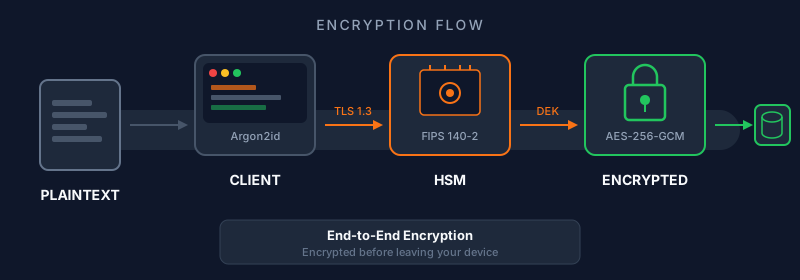
The Vault Unseal Ceremony is the cryptographic protocol by which all three root keys are combined to derive the Data Encryption Key (DEK) required for vault access. This ceremony implements time-bound HMAC verification and produces an AES-256-GCM authenticated cipher for decryption.
Client-Side VMK Derivation
User passphrase processed through Argon2id to derive VMK (never transmitted)
Hardware HMAC Salt Generation
HSM generates deterministic HMAC-SHA512 salt using non-extractable account key
VMK Channel Wrapping
VMK wrapped with ChaCha20-Poly1305 for secure transit to HSM
Time-Bound HMAC Verification
HKDF with time-bound HMAC prevents replay attacks and enforces session expiration
DEK Derivation via HKDF
Combined via HKDF with a 4th ephemeral key derived via time-bound HMAC, producing AES-256-GCM authenticated cipher
// Time-bound session key
timestamp = current_unix_epoch()
time_key = HMAC-SHA512(session_key, timestamp || vault_id)
// Final DEK derivation
DEK = HKDF-SHA512(
ikm = SVMK_secret || AMK_secret || VMK || time_key,
salt = vault_nonce,
info = "SparkVault-Unseal-DEK-v1"
)
// Authenticated decryption
plaintext = AES-256-GCM.Open(DEK, nonce, ciphertext, aad)
XII. Transport Layer Security
All data in transit is protected by TLS 1.3 (RFC 8446) with modern cipher suites providing authenticated encryption, perfect forward secrecy, and protection against downgrade attacks.
Supported Cipher Suites
- TLS_AES_256_GCM_SHA384
- TLS_CHACHA20_POLY1305_SHA256
- TLS_AES_128_GCM_SHA256
Key Exchange Groups
- x25519 (preferred)
- secp256r1
- secp384r1
XIII. Technical Specifications Summary
Cryptographic Algorithms
ML-KEM-1024
Post-quantum KEM, NIST FIPS 203, Module-LWE
AES-256-GCM
AEAD encryption, NIST SP 800-38D, FIPS 197
ChaCha20-Poly1305
AEAD encryption, RFC 8439, VMK channel
HMAC-SHA512
MAC/PRF, FIPS 198-1, RFC 2104
HKDF-SHA512
Key derivation, RFC 5869
Argon2id
Password KDF, RFC 9106, memory-hard
Security Parameters
Symmetric Security
256-bit keys (AES-256, ChaCha20)
MAC Security
512-bit (HMAC-SHA512)
Post-Quantum Security
≥128-bit (ML-KEM-1024)
Hash Security
SHA-512 (256-bit collision resistance)
Authentication Tags
128-bit (GCM, Poly1305)
Entropy Generation
NIST SP 800-90B, hardware RNG
HSM Validation
FIPS 140-2 Level 3
XIV. Mathematical Notation & Definitions
The following notation is used throughout this document to formally specify cryptographic operations and security properties.
Sets & Spaces
| {0,1}n | Set of all n-bit binary strings |
| 𝔽q | Finite field with q elements |
| ℤq | Ring of integers modulo q |
| Rq | Polynomial ring ℤq[X]/(Xn+1) |
| 𝒦 | Key space |
Operations
| x ←$ S | Sample x uniformly at random from S |
| a || b | Concatenation of strings a and b |
| |x| | Length of string x in bits |
| ⊕ | Bitwise XOR operation |
| ⌈x⌉ | Ceiling function |
Security Game Notation
Advantage Functions
| AdvIND-CCA2KEM(𝒜) | Adversary 𝒜's advantage in IND-CCA2 game against KEM |
| AdvAUTHAEAD(𝒜) | Adversary 𝒜's advantage in authenticity game |
| AdvPRFF(𝒜) | Adversary 𝒜's advantage distinguishing F from random |
Complexity Classes
| PPT | Probabilistic Polynomial Time |
| negl(λ) | Negligible function in security parameter λ |
| poly(λ) | Polynomial function in λ |
XV. Formal Security Reductions
SparkVault's security properties are formally reducible to well-studied computational hardness assumptions. We provide security reductions demonstrating that breaking our cryptographic constructions implies solving problems believed to be computationally intractable.
Theorem 1: KEM Security
Let ML-KEM-1024 be instantiated with parameters (k=4, n=256, q=3329). For any PPT adversary 𝒜 making at most qD decapsulation queries:
where ℬ is an efficient reduction and γ ≈ 174 is the failure probability parameter. The Module-LWE problem with these parameters provides ≥192-bit classical security.
Theorem 2: AEAD Security
AES-256-GCM provides IND-CPA security and INT-CTXT authenticity. For any adversary 𝒜 making at most q queries with total plaintext length σ blocks:
Security degrades gracefully with the birthday bound on the number of blocks encrypted under a single key.
Theorem 3: Key Derivation Security
HKDF-SHA512 is a secure key derivation function when HMAC-SHA512 is a PRF:
where εextract is negligible when the input key material has sufficient min-entropy.
Theorem 4: HSM-Bound HMAC Security
The HSM-bound HMAC-SHA512 provides PRF security with non-extractable keys:
HSM-bound keys provide hardware attestation and physical tamper resistance. Key material never leaves the FIPS 140-2 Level 3 boundary, preventing key extraction attacks.
Compositional Security
The Triple Zero-Trust architecture composes individual primitive securities. Under the assumption that compromising the combined system requires breaking at least one primitive:
// Combined system security
AdvSV(𝒜) ≤ min(
AdvIND-CCA2ML-KEM-1024(𝒜),
AdvPRFHMAC-SHA512(𝒜),
AdvAEAES-256-GCM(𝒜),
AdvKDFHKDF-SHA512(𝒜)
)
XVI. Side-Channel Attack Mitigations
Side-channel attacks extract secret information through physical characteristics of cryptographic implementations rather than mathematical weaknesses. SparkVault implements comprehensive mitigations against timing, cache, power, and electromagnetic side-channels.
Constant-Time Operations
- • All comparisons use constant-time equality checks
- • No secret-dependent branching or memory access
- • Fixed iteration counts independent of input
- • Scalar multiplication via Montgomery ladder
Cache-Timing Resistance
- • AES-NI hardware instructions bypass cache
- • No table lookups with secret-dependent indices
- • Bitsliced implementations where applicable
- • Memory access patterns independent of secrets
Memory Protection
- • Secure memory allocation with guard pages
- • Immediate zeroization of sensitive data
- • Memory locking to prevent swapping (mlock)
- • Stack canaries and ASLR enabled
Power Analysis Resistance
- • HSM provides physical isolation
- • Algorithmic blinding for RSA operations
- • Randomized projective coordinates for ECC
- • Constant power consumption profiles
Secure Memory Zeroization
All sensitive cryptographic material is securely erased immediately after use:
// Secure zeroization (compiler-safe)
volatile uint8_t *p = secret_key;
size_t n = sizeof(secret_key);
while (n--) *p++ = 0;
memory_barrier(); // Prevent reordering
// Or platform-specific secure_zero:
explicit_bzero(secret_key, sizeof(secret_key));
SecureZeroMemory(secret_key, sizeof(secret_key)); // Windows
XVII. Nonce & Initialization Vector Management
Nonce uniqueness is critical for AEAD security. Reusing a nonce with the same key catastrophically breaks confidentiality and authenticity. SparkVault implements multiple strategies to guarantee nonce uniqueness across all cryptographic operations.
Security Requirement
For AES-GCM with 96-bit nonces, nonce reuse reveals the XOR of plaintexts and enables forgery attacks. For ChaCha20-Poly1305, nonce reuse similarly compromises security. Our nonce management ensures P(collision) < 2-64 under normal operation.
Counter Mode (Primary)
Used for sequential encryption operations within a session:
nonce = session_id (32-bit) || counter (64-bit)
// Counter incremented after each encryption
// Session ID unique per key instantiation
Random Nonce (Stateless)
Used when counter state cannot be maintained:
nonce = CSPRNG(96 bits)
// Birthday bound: 2^48 encryptions
// before P(collision) = 2^-32
Nonce Construction by Context
| Context | Algorithm | Nonce Strategy | Size |
|---|---|---|---|
| Data-at-rest | AES-256-GCM | Random (HSM-generated) | 96 bits |
| VMK Channel | ChaCha20-Poly1305 | Counter + Session ID | 96 bits |
| Session Keys | AES-256-GCM | Derived (HKDF + context) | 96 bits |
| Key Wrapping | AES-256-GCM | Random (stored with ciphertext) | 96 bits |
XVIII. Cryptographic Agility
Cryptographic agility enables SparkVault to migrate to new algorithms if vulnerabilities are discovered in current primitives, without requiring re-encryption of all existing data. Our architecture supports versioned algorithm negotiation and transparent migration paths.
Algorithm Versioning
Each encrypted object includes an unencrypted header specifying the cryptographic suite version:
// Ciphertext format
struct EncryptedObject {
version: u8, // Algorithm suite version
kem_id: u16, // KEM algorithm identifier
aead_id: u16, // AEAD algorithm identifier
kdf_id: u16, // KDF algorithm identifier
encapsulated_key: [u8],
nonce: [u8; 12],
ciphertext: [u8],
tag: [u8; 16],
}
Current Suite (v1)
- KEM: ML-KEM-1024
- AEAD: AES-256-GCM, ChaCha20-Poly1305
- KDF: HKDF-SHA512
- Signature: Ed25519 (API auth)
Reserved (Future v2)
- KEM: ML-KEM-1024 or successor
- Signature: ML-DSA-87 (Dilithium)
- Hash: SHA-3-512 (if SHA-2 weakened)
- AEAD: AES-256-GCM-SIV
Migration Protocol
Announcement Phase
New algorithm suite published with 6-month deprecation notice for old suite
Dual Support
System accepts both old and new suites; new encryptions use new suite
Background Re-encryption
Optional background process re-encrypts existing data with new suite
Deprecation
Old suite support removed after migration window closes
XIX. Audit Logging & Non-Repudiation
SparkVault maintains cryptographically-verifiable audit logs of all security-relevant operations. These logs provide non-repudiation and tamper evidence through hash chain construction, enabling forensic analysis and compliance reporting.
Hash Chain Construction
Each audit log entry includes a hash of the previous entry, creating a tamper-evident chain:
// Audit log entry structure
entry[n] = {
sequence: n,
timestamp: RFC3339,
event_type: string,
actor_id: hash(user_id),
resource_id: hash(resource),
action: string,
prev_hash: SHA-256(entry[n-1]),
signature: HMAC-SHA256(entry, audit_key)
}
Logged Events
- • Authentication attempts (success/failure)
- • Key generation and derivation
- • Encryption and decryption operations
- • Vault unseal ceremonies
- • API key creation and revocation
- • Permission changes
- • Data deletion requests
Security Properties
- Tamper Evidence: Hash chain detects modifications
- Non-Repudiation: HMAC signatures prove authenticity
- Append-Only: No deletion or modification of entries
- Privacy-Preserving: User IDs hashed in logs
- Retention: 90 days (configurable per plan)
Verification Protocol
Audit log integrity can be verified by recomputing the hash chain:
// Verify audit log integrity
function verify_audit_chain(entries):
for i in 1..len(entries):
expected_hash = SHA-256(entries[i-1])
if entries[i].prev_hash != expected_hash:
return TAMPERED_AT(i)
if !HMAC_verify(entries[i], audit_key):
return SIGNATURE_INVALID(i)
return VALID
XX. Incident Response Procedures
SparkVault maintains incident response procedures for cryptographic emergencies including key compromise, algorithm breaks, and security breaches. Our response framework prioritizes data protection while maintaining service availability.
Key Compromise Response
- 1. Immediate Isolation: Compromised key removed from active use within 15 minutes
- 2. Key Rotation: New keys generated and distributed to affected systems
- 3. Re-encryption: Data protected by compromised key re-encrypted with new key
- 4. Notification: Affected users notified within 72 hours per breach notification requirements
- 5. Forensics: Root cause analysis and audit log review
Algorithm Vulnerability Response
- 1. Assessment: Evaluate severity and exploitability of vulnerability
- 2. Mitigation: Deploy countermeasures if available (e.g., parameter changes)
- 3. Migration: Activate cryptographic agility to transition to secure alternative
- 4. Communication: Publish security advisory with timeline and recommendations
HSM Failure Response
- 1. Failover: Automatic failover to standby HSM cluster
- 2. Diagnosis: Hardware diagnostics and tamper detection verification
- 3. Recovery: Key restoration from encrypted backup if required
- 4. Replacement: Failed HSM securely decommissioned and replaced
Response Time SLAs
| Severity | Detection | Containment | Resolution |
|---|---|---|---|
| Critical | < 15 minutes | < 1 hour | < 24 hours |
| High | < 1 hour | < 4 hours | < 72 hours |
| Medium | < 4 hours | < 24 hours | < 7 days |
XXI. References & Bibliography
NIST Standards
- [FIPS 197] Advanced Encryption Standard (AES). NIST, 2001.
- [FIPS 198-1] The Keyed-Hash Message Authentication Code (HMAC). NIST, 2008.
- [FIPS 203] Module-Lattice-Based Key-Encapsulation Mechanism Standard. NIST, 2024.
- [SP 800-38D] Recommendation for Block Cipher Modes of Operation: Galois/Counter Mode (GCM). NIST, 2007.
- [SP 800-90B] Recommendation for the Entropy Sources Used for Random Bit Generation. NIST, 2018.
- [FIPS 140-2] Security Requirements for Cryptographic Modules. NIST, 2001.
IETF RFCs
- [RFC 2104] Krawczyk, H., Bellare, M., Canetti, R. "HMAC: Keyed-Hashing for Message Authentication." 1997.
- [RFC 5869] Krawczyk, H., Eronen, P. "HMAC-based Extract-and-Expand Key Derivation Function (HKDF)." 2010.
- [RFC 7748] Langley, A., Hamburg, M., Turner, S. "Elliptic Curves for Security." 2016.
- [RFC 8439] Nir, Y., Langley, A. "ChaCha20 and Poly1305 for IETF Protocols." 2018.
- [RFC 8446] Rescorla, E. "The Transport Layer Security (TLS) Protocol Version 1.3." 2018.
- [RFC 9106] Biryukov, A., Dinu, D., Khovratovich, D. "Argon2 Memory-Hard Function for Password Hashing and Proof-of-Work Applications." 2021.
Academic Publications
- [Kyber] Avanzi, R., et al. "CRYSTALS-Kyber: Algorithm Specifications and Supporting Documentation." NIST PQC Submission, 2020.
- [Curve25519] Bernstein, D.J. "Curve25519: New Diffie-Hellman Speed Records." PKC 2006.
- [ChaCha20] Bernstein, D.J. "ChaCha, a variant of Salsa20." SASC 2008.
- [Poly1305] Bernstein, D.J. "The Poly1305-AES Message-Authentication Code." FSE 2005.
- [Argon2] Biryukov, A., Dinu, D., Khovratovich, D. "Argon2: The Memory-Hard Function for Password Hashing and Other Applications." Password Hashing Competition Winner, 2015.
- [GCM] McGrew, D., Viega, J. "The Galois/Counter Mode of Operation (GCM)." NIST, 2004.
Security Analysis
- [LWE] Regev, O. "On Lattices, Learning with Errors, Random Linear Codes, and Cryptography." STOC 2005.
- [MLWE] Langlois, A., Stehlé, D. "Worst-Case to Average-Case Reductions for Module Lattices." Designs, Codes and Cryptography, 2015.
- [Shor] Shor, P.W. "Algorithms for Quantum Computation: Discrete Logarithms and Factoring." FOCS 1994.
- [Grover] Grover, L.K. "A Fast Quantum Mechanical Algorithm for Database Search." STOC 1996.
Deploy SparkVault's multi-layered cryptographic architecture to achieve mathematically-guaranteed data confidentiality.
Experience Cryptographic Excellence