
Security so excessive,
it's almost paranoid.
Most encryption is a door lock, easily opened with a credit card. SparkVault is two deadbolts, a swing bar, security chain, and reinforced hinges. Way more than you need. But you'll sleep easy.
The Industry Problem
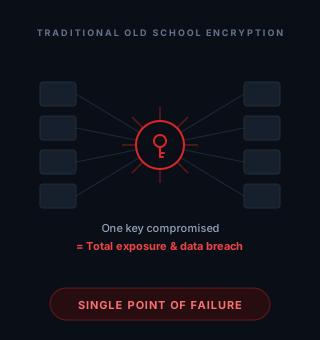
Most encryption has a fatal flaw.
Most companies encrypt with a single AES key. If that key leaks (a developer's laptop, a misconfigured server, a compromised backup), everything is exposed.
Real World: LastPass (2022)
One developer's machine. One master key. Millions compromised.
This isn't theoretical. It's happening constantly. Single-key encryption has a single point of failure.
Three keys. Three companies.
Zero single points of failure.
SparkVault requires three independent keys, held by three independent entities, secured with three independent algorithms. A breach of any single party, including us, reveals nothing.
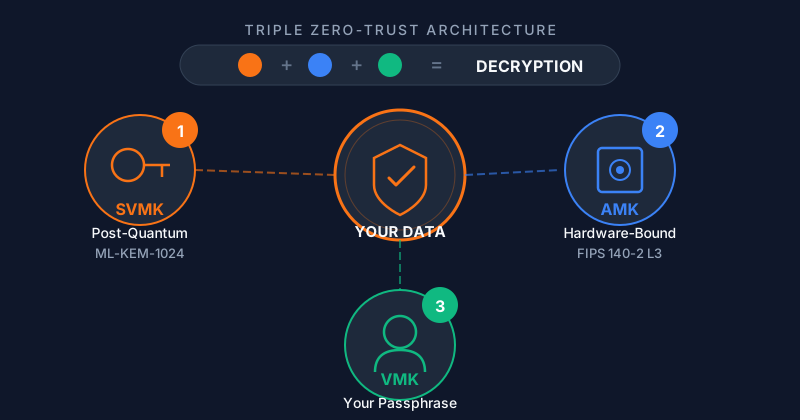
SparkVault Master Key (SMK)
Post-quantum ML-KEM-1024 encryption. Held in isolated infrastructure with FIPS 140-2 Level 3 hardware security modules.
Account Master Key (AMK)
HMAC-SHA512 derived. Secured in FIPS 140-2 Level 3 certified HSM hardware that even SparkVault's engineers cannot extract from.
Vault Master Key (VMK)
Never transmitted. Never stored. Derived client-side with Argon2id. We literally cannot help you if you lose it.
The Forge (Real-Time Cryptographic Transducer)
The barrier your data passes through for secure transformation, where all three keys converge. As your data streams through the Forge, all three keys are injected simultaneously, performing an atomic cryptographic transformation the instant all pieces align. Clear bytes flow in, emerge as hardened Ingots, and are stored securely in your Vault. On retrieval, the reverse occurs: keys reconverge, Ingots are decrypted on-the-fly, and plaintext streams securely to the requesting client. Your data is never at rest unprotected.

Is this overkill? Probably.
Will SparkVault keep your data safe? Absolutely.
Drop-in Security
Let us handle the cryptography.
You build your business.
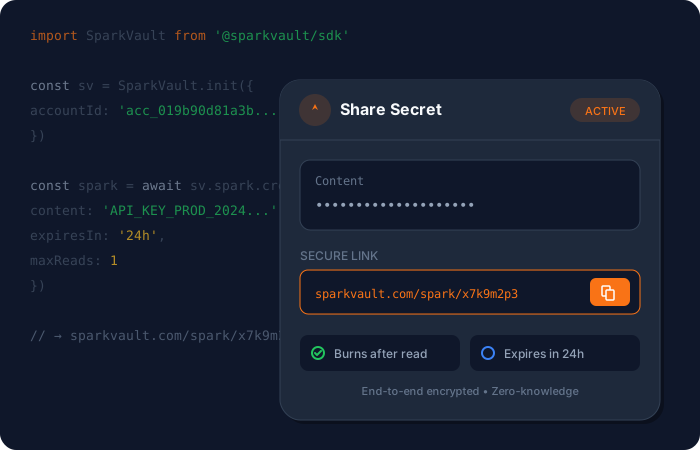
SparkVault is a cryptographic layer that drops into any stack. We harden the weak points that hackers actually target: secrets in transit, credentials in chat, keys in config files. You focus on shipping features instead of security architecture.
- REST API integration in minutes, not months
- No cryptography expertise required
- Compliance-ready from day one (FIPS 140-2, SOC 2)
- Quantum-safe today, not "someday"
Elements → Apps
Three Primitives.
Infinite possibilities.
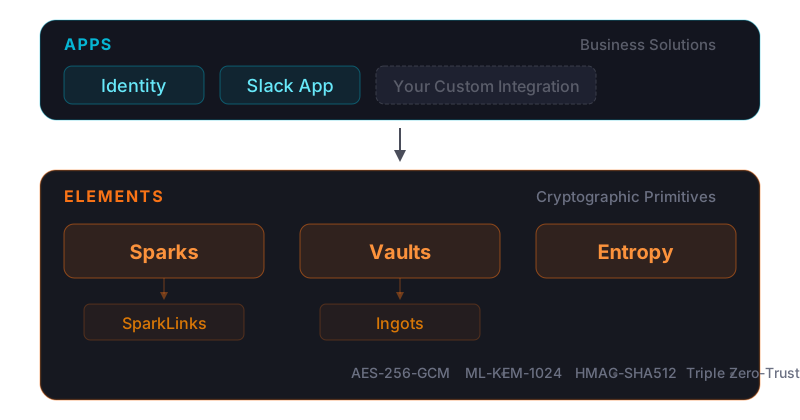
SparkVault's cryptographic layer is built on three foundational primitives called Elements: irreducible security concepts that integrate into any business workflow and serve as the data security foundation for every app.
Explore the PlatformSparks
EphemeralBurn-after-read secrets that self-destruct after a single access. Zero persistence.
Vaults
PersistentTriple-key, zero-knowledge encrypted storage. We cannot decrypt your data.
Entropy RNG
HardwareCryptographic randomness from FIPS 140-2 Level 3 validated hardware security modules.
Enterprise-grade by default.
Not by upgrade.
Every SparkVault deployment ships with the same cryptographic infrastructure that protects the most sensitive data on the planet.
FIPS 140-2
Level 3 validated cryptographic modules. Tamper-evident, tamper-resistant hardware.
SOC 2 Type II
Continuous monitoring. Annual third-party audits. Full audit trail.
Zero-Knowledge
We cannot read your data. By design, not by policy. Mathematically proven.
Post-Quantum
ML-KEM-1024 (Kyber). NIST-approved. Quantum-computer resistant today.
REST API
OpenAPI spec. SDK for every major language. Drop-in integration.
HSM Backed
Keys secured in dedicated hardware modules. Non-extractable by design.
Trusted by security-obsessed teams
SparkVault is implemented in companies where security isn't optional.
We needed an atomic burn-on-read secret transport system that could scale across millions of customer endpoints without becoming a bottleneck. SparkVault delivered.
James R.
CTO, Fortune 500
Our security auditors were initially skeptical. After reviewing SparkVault's implementation, they called it 'the gold standard.'
Marcus W.
VP Engineering, Healthcare Platform
We evaluated every secrets management solution on the market. SparkVault was the only one where we couldn't find a theoretical attack vector.
Sarah C.
CISO, Series C Fintech
The zero-knowledge architecture means we can prove to regulators that even we can't access patient data. That's not a feature, that's a compliance revolution.
Dr. Anita P.
Chief Medical Officer, Telehealth Company
Post-quantum encryption isn't a buzzword here. When our board asked about quantum threats, we showed them SparkVault's ML-KEM implementation. Meeting over.
David K.
Head of Security, Enterprise SaaS
Finally, a secrets manager that developers actually want to use. The API is clean, the docs are excellent, and security happens by default.
Lisa T.
Staff Engineer, Crypto Exchange
Join the teams that trust SparkVault with their most sensitive data.